Nano Ecosystem Round Up of 2026 So Far

AI agents are now spending money by themselves. They picked Nano.
Since January 2026, the first autonomous AI agents have started transacting on Nano mainnet, the developer stack to enable them has shipped in under 90 days, and the network itself is hardening to commercial grade in parallel. We wanted to collate all the happenings so far - from that agent infrastructure and node development to community-built tools, media coverage, and the numbers that show just how much is going on under the hood. Grab a cuppa as there is a lot to get through, including a sneak peek at V29!
Node Development
V29 Piotric: integrity, resilience and bootstrap improvements
V29, named Piotric, covers more ground than its predecessor. Where V28 concentrated on network resilience and the Bounded Block Backlog, V29 reaches broadly across the node stack and as such, is not defined by a single headline feature.
Ledger integrity
The most visible new protection in V29 is a coordinated set of fail-fast consistency checks. The representative weight map, one of the node's most critical components, used directly in quorum decisions, is now verified against the ledger on startup. Any divergence immediately aborts the process and writes diagnostic detail to the log. A corresponding balance consistency check does the same for ledger balances. Silent database corruption, which has historically been observed on nodes running the RocksDB backend, will now be caught immediately rather than propagating downstream. For operators who need to bypass these checks in specific circumstances, a --skip_consistency_check flag has been added.
Bootstrap
V29 fixes a performance regression introduced by V28's Bounded Block Backlog. The fixed 100,000-block limit was protecting the live network from resource exhaustion but also limiting bootstrap effectiveness by reducing the impact of optimistic elections during sync. V29 replaces this with a dynamic heuristic that raises the backlog limit progressively during bootstrap until the configured block count is reached, restoring sync speed without compromising live network protection.
Topology indexing
V29 introduces topology indexing support, adding topo_height computation to the ledger processor and implementing a topology index backfill. Two new CLI commands: --populate_topo_index and --drop_topo_index which give operators direct control over the index. This is low-level groundwork rather than a user-facing feature, but it gives the node better structural information about the ledger, creating a foundation for smarter and more scalable synchronisation behaviour in future releases.
New operator tooling
Three new CLI flags arrive in V29 that meaningfully improve how operators manage their nodes in practice. --database_upgrade handles explicit database upgrade operations. --enable_rpc allows RPC to be enabled at startup via flag rather than configuration alone. --rollback provides a mechanism for ledger rollback operations. These are the kinds of additions that reduce operational friction and make production nodes easier to manage with confidence.
Scheduler and vote path
The election scheduler has been substantially reworked in V29, rewritten to use a priority pool rather than its previous design. The optimistic scheduler main loop has also been reworked, and the request aggregator has been replaced with a dedicated vote replier. Election schedulers now receive explicit dependencies rather than reaching for them implicitly. These changes are largely invisible at the surface but represent a significant improvement to how the node handles elections internally, particularly under load.
Wallet handling
V29 includes a set of wallet-lock related improvements that have been a quiet source of operational friction. Unlock now correctly repopulates the representative key cache. Locked-wallet receivable scan behaviour has been made more predictable. Representative keys are cached more intelligently when the wallet is locked. These are not headline features, but they reduce confusion and improve day-to-day reliability for node operators running wallets in production.
Database backend
The RocksDB and LMDB backend work in V29 builds on the migration foundation laid in V28. Notable additions include optimisation of the RocksDB clear operation, a fix for LMDB null pointer undefined behaviour on empty values, read-only mode enforcement for LMDB databases, improved LMDB error detail in wallet store exceptions, a macOS debug build sandbox fix, and extraction of the LMDB wallet storage backend into its own component. The migration implementation itself now refuses to run if the source LMDB database is missing or a RocksDB destination already exists, and logs progress table by table during copy.
Networking and observability
The TCP channel queue has been optimised for improved networking efficiency. Negative block rate values in the node monitor are now handled correctly. The node will warn when ledger processing cooldown is active. A database value type refactor improves internal code clarity throughout.
Bootstrap Strategy Improvements
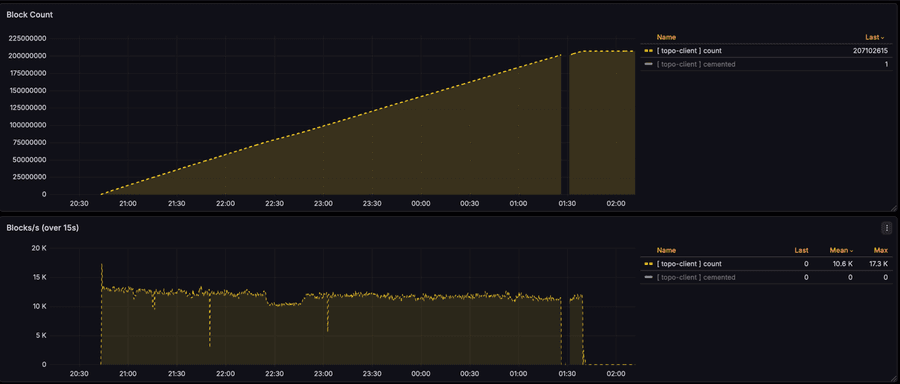
Piotr has been working on a new bootstrap strategy that could significantly improve the time it takes for a node to sync from scratch. Local test results show a full bootstrap completing in around five hours at approximately 10,000 blocks per second, which is a meaningful step forward. Beyond faster onboarding for new node operators, the work also has potential to improve mainnet maximum CPS, as out-of-sync nodes would be able to resync more quickly. You can follow the discussion here.
Naming V29 Piotric
Those who have followed Nano's node releases will know that the names are never arbitrary. Follis, Lydia, Siglos, Daric, V26 Tremissis, V27 Denarius and V28 Electrum; each one an ancient coin with a story behind it. V29 continues that tradition with a new twist.
The Daric was minted under the Persian king Darius, and became a standard for purity and trust. The Piotric takes that name forward: same construction, new meaning. Where the Daric honoured the king who struck it, the Piotric honours Piotr, Nano Foundation developer, long-time contributor, and the person behind some of the most significant node improvements of recent years including bootstrapping, election handling and efficiency work that continues to shape how the network performs today.
The name also carries the Daric's legacy forward rather than back. High-purity, trusted, a natural step toward Aureus, the Roman gold standard, which is exactly where V29 sits on Nano's pathway forward.
Naming a node release after a person is not something that happens lightly. It is a recognition of years of work done steadily, thoroughly, and with results that speak for themselves. Congratulations, Piotr!
V28.1 and V28.2: Electrum patch releases
Following the landmark V28 Electrum release, which marked the beginning of Nano's transition to commercial grade, two patch releases were shipped in the first half of the year. V28.1 resolved occasional node crashes experienced by some V28.0 operators caused by missing sideband in election blocks. A straightforward but important fix for network stability.
V28.2 went further, introducing a ledger consistency check at startup so that corrupted ledger databases are detected immediately rather than going undetected and causing downstream issues. It also added representative weights verification and comprehensive ledger integrity checks, fixed race conditions, missing notifications and online representative weight sampling issues, and extended the bootstrap RPC commands with bootstrap_status, bootstrap_reset and bootstrap_priorities to help node operators debug and monitor the ascending bootstrapper.
V28.2 is the currently recommended version and all node operators should have upgraded. Release notes at docs.nano.org/releases/release-v28-2.
Developer Fund Allocation
The Nano Developer Fund run by Bob (Gr0vity) has been put to work with 7,500 XNO allocated to support a formal, peer-reviewed academic paper exploring consensus variations for the Nano protocol thanks to Fiono. The paper will be presented at The International Symposium on Distributed Computing 2026 (DISC) which is an international forum on the theory, design, analysis, implementation and application of distributed systems and networks. It is exactly the kind of long-term, foundational investment the community has been building toward. Read the full announcement with more detail on Reddit.
Nano and the Rise of AI Agents
If there is one theme that has defined early 2026 for Nano, it is AI agents. The x402 protocol, which enables machines to pay for API access with instant, feeless Nano transactions, has gone from a concept to a live ecosystem in a matter of months.
NanoGPT: x402 AI inference, no API key required
NanoGPT added x402 support, making it the first AI platform to offer x402 payments across multiple cryptocurrencies. For agents, the flow is exactly what the protocol promises: make an API call, receive a 402 Payment Required response, pay in XNO, and get the model response back. No API key, no account, no onboarding. Overpayments and billing reconciliation are handled automatically with instant refunds. A natural fit for the agent economy, and a meaningful signal that x402 is landing in production AI infrastructure. Find out more at nanogpt.com.
x402nano: the developer resource hub
Community developer NanoCharts open-sourced x402nano on GitHub in February, giving developers a single resource for integrating Nano payments over the x402 protocol. A Facilitator core component followed in March, allowing anyone to run their own Facilitator endpoint for third-party resource servers or self-host for their own use. Find both at github.com/x402nano and github.com/x402nano/facilitator.
NanoRoute: open-source x402 payment facilitator
GrassfedCap open-sourced NanoRoute, an x402 payment facilitator for Nano that lets AI agents pay for APIs using XNO through the x402 protocol. In March, he also routed the first real AI agent micropayment through NanoRoute on Nano mainnet. This is real XNO, real routing fees, real on-chain settlement. The code is available at github.com/robgilmore26/nanoroute.
x402.NanoSession: internet-native API micro-payments
Community developer cbrunnkvist announced x402.NanoSession, a protocol specification for internet-native API micro-payments over HTTP using Nano. An early look at the spec is available at csi.ninzin.net/x402.NanoSession.
Nano-agent-wallet: TypeScript SDK for agent payments
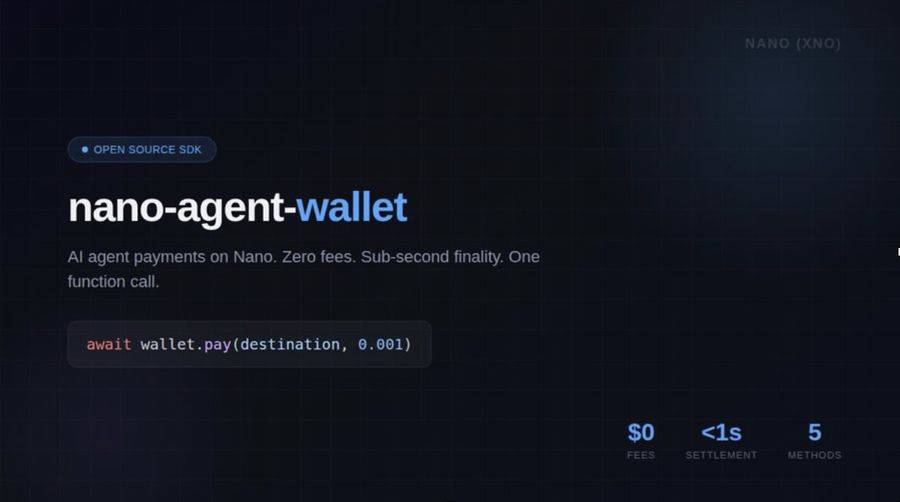
At the end of March, GrassfedCap open-sourced nano-agent-wallet, a TypeScript SDK that gives AI agents a fully functional Nano wallet in a single function call. Zero fees, sub-second finality, five payment methods. Exactly what the agent economy needs. The SDK is available at github.com/robgilmore26/nano-agent-wallet.
Pawl: the first autonomous AI agent on Subnano
In January, community developer Noom launched Pawl, a canine autonomous agent running via Clawbot on Subnano. Pawl can buy posts with Nano via x402, comment on articles, tip authors and even create posts entirely on his own. It is a working proof of concept that Nano is ready for machine-to-machine commerce right now, no smart contracts or bridges required. Meet Pawl at subnano.me.
Nano Bazaar: the AI-to-AI marketplace
In February, Noom launched Nano Bazaar live on Chirag’s Strawberry Labs Youtube channel , an AI-to-AI agent marketplace where agents can post offers, accept jobs and exchange encrypted deliverables, all paid in Nano with instant settlement and zero fees. Alongside the marketplace, BerryPay CLI Wallet also launched, giving agents a command-line-first payment interface. The marketplace is live at nanobazaar.ai.
Platforms/Services: New & Updated
Nagora: P2P marketplace
Nagora went live in April as a peer-to-peer marketplace where you list, sell and get paid in Nano. Every trade is buyer-protected by escrow, sellers have ratings and direct messaging, and withdrawals settle in under a second. From sofas, to Dutch classes, we are excited to see how this marketplace grows!
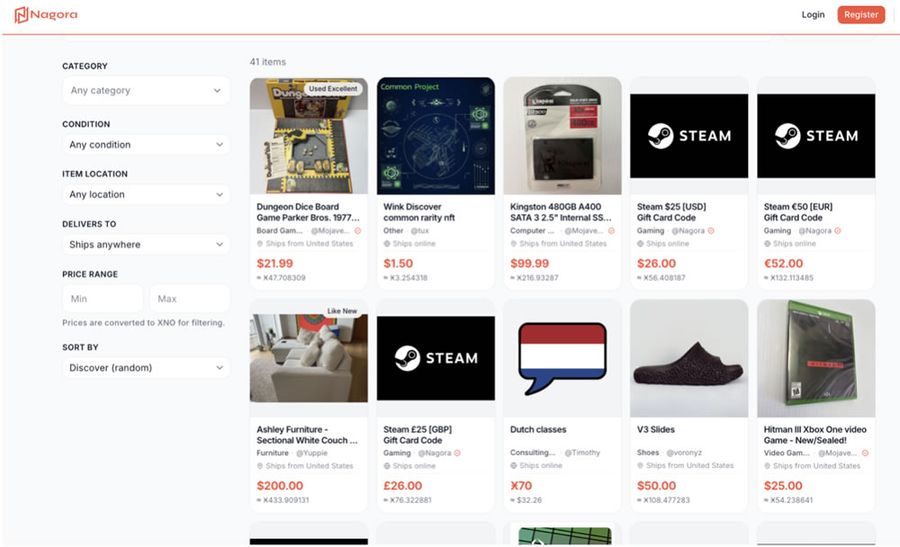
If you sell on eBay, Amazon or Etsy and want to see how much you are leaving on the table in fees, Nagora has also launched a calculator to show you exactly that. Shop at nagora.shop and try the calculator at nagora.shop/calculator.
Nanswap Pro: instant offchain swaps
Nanswap launched Nanswap Pro in February, bringing instant offchain swaps and limit orders to the Nano ecosystem. XNO to NanUSD and back, with market, +1%, +5% and +10% limit options, all in one clean interface. Access it at nanswap.com/pro.
MuPay: privacy-conscious Nano payments
MuPay was shared in April with a simple premise: online payments should be usage-based, privacy-conscious and controlled by the user. Most payment rails break that model. MuPay lets users define who can charge them, what they can charge for and how much. Built on Nano, so it is instant and feeless by default. Follow its progress towards launch on mupay.io.
Rimest: Nano payment system
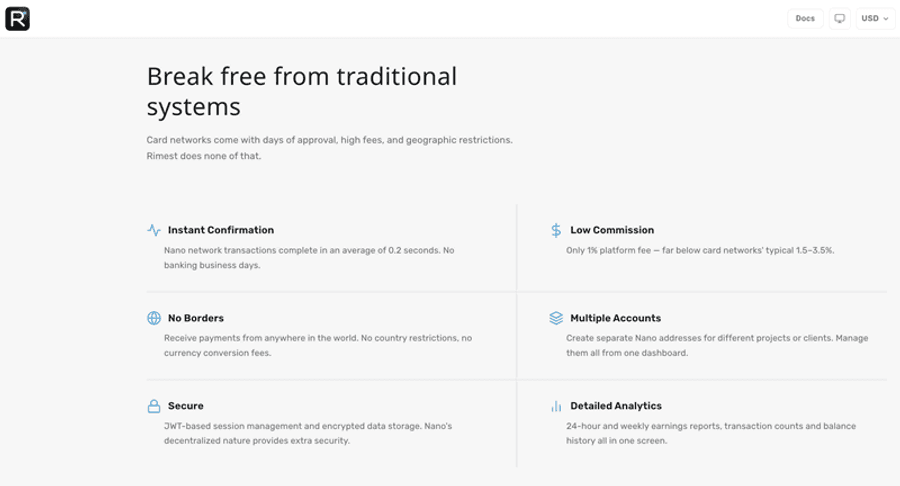
Rimest launched in May as a zero-fee payment processor built on the Nano network, aimed at merchants and creators who want straightforward payment infrastructure without the overhead. The pitch is simple: accept and send Nano payments with no transaction fees, fast integration, and settlement in seconds. For anyone selling digital goods, running a creative business or just wanting to get paid without a payment processor taking a cut, Rimest puts the full amount in your hands, instantly. Visit rimest.com.
Nano.Auction: feeless live auctions
Nano.Auction went live in April with the Genesis Key Founder Drop, offering 99 slots at 0.2 XNO or more. The platform runs feeless auctions where bids are made in XNO and overbid amounts are automatically refunded instantly. It is a natural fit for Nano, where the instant and feeless nature of the network means even very small bids create no friction. Browse active auctions at nano.auction and we look forward to the platform coming out of beta.
TimeProof.me: permanent messages on IPFS
Pay a small amount of Nano and your message gets pinned to IPFS permanently with a CID anyone can verify through any gateway. Use cases include timestamped statements, predictions, art, manifestos and proof-of-publication. No KYC, no chargebacks, no card processor that can pull the plug on a permissionless publishing service. Try it at timeproof.me.
XNO Chat: earn XNO from your chat room
XNO Chat launched in early 2026 with a simple idea. Create a chat room on any topic and earn XNO tips from the pool wallet based on visitor traffic. The more visitors, the more you earn per minute. Chat rooms are currently free to create. Check it out at xno-chat.me.
AI Nano Music: monthly AI music contests
AI Nano Music launched as a platform for monthly AI music generation contests powered by XNO. Creators submit AI-generated tracks, the community listens and votes, and winners earn Nano. It is a real economy for AI-generated creative work, built on a currency that makes micropayments easy ainanomusic.com
feeless.money: Nano education chatbot
feeless.money is a donation-funded Nano education chatbot that answers questions about Nano in any language, with no signup, no fees and no KYC. After a 200% rise in conversations, it is now officially listed on the Nano Hub in the Education category. Ask it anything at feeless.money.
NanChat: launches developer integration guide
NanChat has published a developer guide making it straightforward to add "Pay with NanChat" or "Login with NanChat" to any app. No SDK, no API keys, no server-side dependency on NanChat - it runs on Nano cryptography alone.
Payments open NanChat with a prefilled request in one tap. Login authenticates users by verifying a signed message from their Nano account. Two powerful integrations, zero infrastructure overhead. Read the developer docs at nanchat.com/developers/
Developer Tools and Infrastructure
RPC.Nano.To: 2026 refresh
Developer Esteban also shipped a full 2026 refresh of the platform, including an updated Nano and Wallet package, increased free RPC limits, fiat billing for monthly plans and an improved Developer Dashboard. A built-in live faucet was also added, so developers can claim Nano without leaving their code editor. Explore it at rpc.nano.to.
Nano Adoption Awards: get paid to learn
Alongside the RPC.Nano.To refresh, Esteban launched Nano Adoption Awards. Complete developer milestones like making your first RPC call, sending your first transaction or reaching 100 sends, and earn Nano for each one. A smart way to lower the barrier to entry and reward developers for actually building. Get started at rpc.nano.to/faucet.
nano25519: fastest Nano cryptography library
Developer Chris released nano25519, described as the fastest library for Nano public key derivation, block signing and signature verification. A low-level but important building block for anyone building on the Nano network. Find it on npm at npmjs.com/package/nano25519.
NanoGate: smart contracts meet Nano
NanoGate opened its public beta in March, enabling smart contract applications to access Nano via the Internet Computer Protocol. No bridges, no wrapping, no oracles. ICP canisters can make direct RPC calls to the Nano network through NanoGate, with over 30 RPC actions available. A significant step toward making Nano programmable without changing what makes it great. Try the beta at nanogate.run.
ArmourNode: new PR for decentralisation
Armour Hosting launched ArmourNode in March, a new node on the Nano network with the goal of strengthening decentralisation and supporting the fast, feeless future of the network. Every new node operator matters and this one reached Principal Representative status within an hour of sharing! Read the announcement here.

OpenWallet Standard adds Nano
OpenWallet Standard added support for Nano in April via a community pull request. A quiet but meaningful step toward broader wallet compatibility for AI agents. Read more here.
FinchPay: EU regulated on-ramp launched 0% purchasing fees for a week
FinchPay relaunched Nano in late 2025, establishing an EU-regulated on-ramp. It provides global Visa/Mastercard coverage (120+ countries) and local payment methods in Brazil, Mexico, and Indonesia. Purchases support EUR, USD, BRL, MXN, and IDR, with a no-KYC flow available for small transactions. This regulated infrastructure increases Nano's accessibility and they kindly had 0% purchasing fees for a week in February - we love this kind of support! Find out more at finchpay.io.
NanoNerd.org: customisable Nano hub
TimeForPlanX launched NanoNerd.org in April as an interactive and customisable Nano hub for the desktop. It includes a chat interface dedicated to Nano, a live XNO Matrix visualiser, directories of wallets, websites and representatives, and live network stats, all wrapped in an all-in-one UI with customisable colours, wallpapers and a choice of Windows XP or macOS interface design. Explore it at nanonerd.org.
Subnano: micro-economy features shipping fast
Subnano shipped a significant round of updates in February, adding post reactions with instant tipping, comment reactions and tipping, a Momentum leaderboard and creator stats. The platform's micro-economy primitives are taking real shape. Explore it at subnano.me.
TheNanoButton: final numbers
Ben launched TheNanoButton.com in February, a simple site that gives away Nano to everyone, humans and AI agents alike, with a single button press.
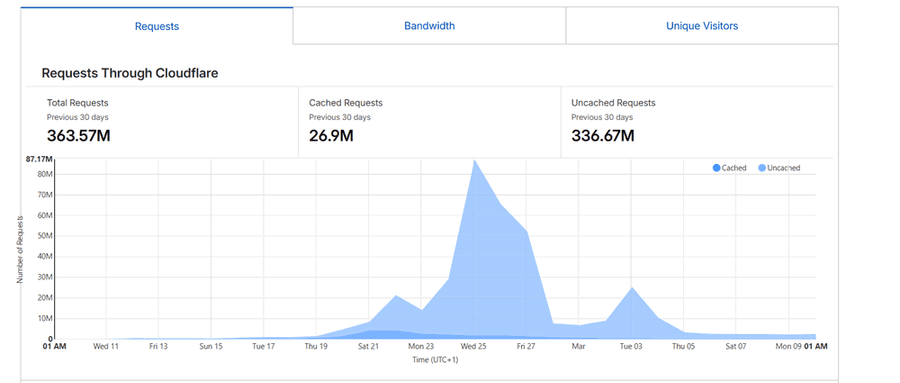
When the button closed in March the final numbers were remarkable: 2,992,007,593 total clicks, 1.36 million unique visitors, 379,823 on-chain transactions, 4,131 XNO given away for free, and 363 million requests served. Every withdrawal confirmed in less than a second. See the site at thenanobutton.com.
NanBTC: wrapped Bitcoin on Nano
Nanswap launched NanBTC in February, a wrapped Bitcoin with zero fees and near-instant transactions, built on Nano backed 1:1 by public BTC reserves. A useful bridge between the two ecosystems and a demonstration of what Nano's rails can do. Find it at nanbtc.com.
Games
The gaming corner of the Nano ecosystem has had a busy start to 2026. Whether you want to farm virtual broccoli, solve a murder mystery, fish for XNO or build a spaceship with your clan, there is something here for you.
Nanogotchi: clans, spaceships, mysteries and more
Nanogotchi has had a remarkable run of updates in 2026. The game, which lets you raise a virtual pet while earning Nano, added the ability to sell broccoli for real Nano, a global chat feature and playability without a wallet, all in the first quarter. Then in April, the team went further still, introducing clans with shared treasuries, spaceship building and full planet conquest mechanics. Forest Horsman, Nanogotchi’s developer also launched Dead Air, a Nano noir murder mystery where you pay XNO to play and earn a percentage back depending on how quickly you solve the case. Every playthrough is different. Play at nanogotchi.com and try Dead Air at nanogotchi.com/mystery.
NanDash: multiplayer minigames
NanDash launched as a web app for multiplayer minigames where you can bet and play with Nano for free. It started as a minigames bot on NanChat and has evolved into a full standalone platform. Play at nandash.com.
Fishing Frenzy: catch and earn XNO
Fishing Frenzy is a real-time multiplayer game where every catch pays out Nano directly to your wallet. It features 16 or more species, 1.5x tournament rewards and live leaderboards. Currently running as a faucet with entertainment built in. Find it at xno-fishing.space.
Nano BrowserQuest: now on Roblox
Community developer Dry_Potential5880 has been working on a Roblox port of the classic Nano BrowserQuest game. Players earn small amounts of Nano through achievements and by defeating the skeleton king, and can spend Nano on in-game items. The game is live here.
Office Chair Curling
A fun one to close the games section: you can now buy Office Chair Curling with Nano via nanopay.me. Easy checkout, instant settlement. Available at osuika.games.
Nano in the Media
What If Money Worked Like Email?
In February, Nano Foundation Director George Coxon published a piece for EcoHustler making the case that email made communication instant, free and borderless — while money still works like a 1980s postal service. With 1.3 billion people locked out of financial systems and 1.2 billion climate-displaced people projected by 2050, the argument has real urgency. Read it at ecohustler.com.
HackerNoon: a currency that actually works
HackerNoon published a piece in March making the case for Nano as a currency with genuine real-world utility, held back not by technology but by economics. A thoughtful and well-circulated read for anyone who wants a plain-English primer on what makes Nano different. Read it at hackernoon.com.
Record NPM downloads
In February, the nanocurrency NPM package hit a record 176,569 monthly downloads, the highest figure ever recorded for the package. Developer interest in building on Nano is clearly growing. Track it at npmjs.com/package/nanocurrency.
Nano song on Spotify
The Crypto Corner Shop team released a nano-inspired song to Spotify in February. Stream it at open.spotify.com.
The Raw: weekly Nano micro magazine
Community member moncho launched The Raw in February, a weekly micro magazine for the Nano community. Issue 01 arrived in week 8 of 2026 and features an editorial, a look at the Nano Preside, Rawdom (the history of coffee) and the cold wallet. A charming and different kind of community media.
The Numbers That Matter
Beyond the individual launches and updates, a few numbers are worth stepping back to appreciate.
- TheNanoButton had 363 million requests and 1.36 million unique visitors, all confirmed in under a second, all with zero fees.
- The nanocurrency NPM package hit a record 176,569 downloads in a single month in February 2026.
- The entire x402 developer stack - from Pawl's first autonomous transaction in January to a full suite of open-source tools, SDKs and marketplaces shipped in under 90 days.
- feeless.money saw a 200% rise in conversations, driven by people around the world asking questions about Nano in their own language, with no signup and no fees.
- V29 changeset touches 672 files - 67.5% of the tracked repository with 71,391 lines of churn across the codebase..
- 7,500 XNO from the Developer Fund is going toward a peer-reviewed academic paper on consensus variations, to be presented at a Tier A conference.
- Not a single network fee has been paid on the Nano network since it began operation over ten years ago.
If you want to try Nano for the first time, visit nano.org/en/try-nano. If you want to build on Nano, start at docs.nano.org. And if you want to see everything the ecosystem has to offer, explore hub.nano.org.
Here is to everything the second half of 2026 brings Ӿ
Nano Foundation does not endorse or approve products and/or services used or developed by third parties. Any links to third party software or sites are for informational purposes only. Nano Foundation bears no responsibility for the operability, accuracy, legality or content of third party products and/or services. Any questions regarding third party material should be directed to that party.