Zero network fees
Whether you send a few cents or a large sum, the network adds no fee.

Send money worldwide in under a second, with zero network fees. For you, your business and whatever you’re building.
Illustration of live transaction speed
Illustration, based on a 338 ms observed average

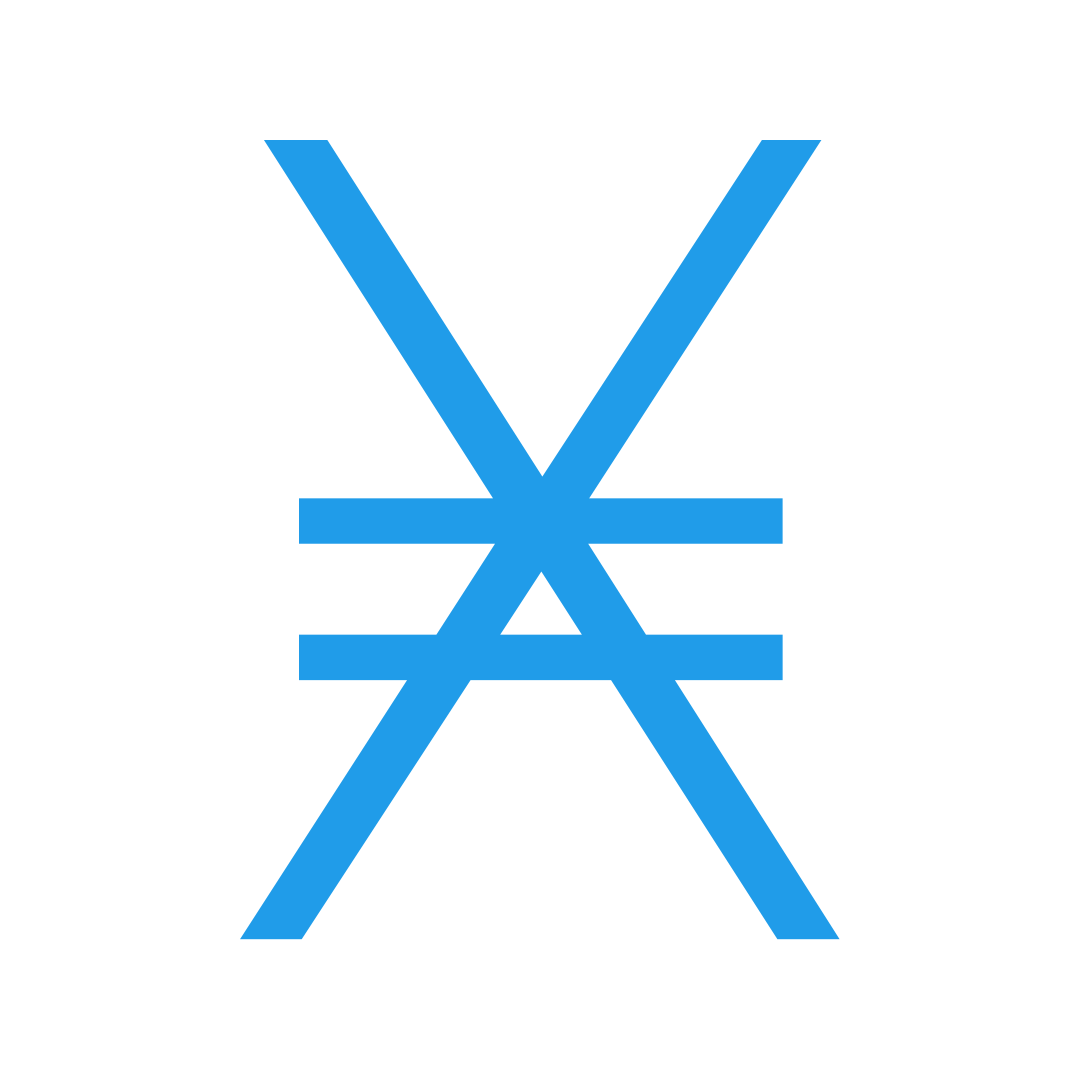
Official symbol · original artwork, unaltered
Payment previewIllustrative interface · not a wallet or live payment
One payment, different possibilities. Select a use case above.
Whether you send a few cents or a large sum, the network adds no fee.
That is the average confirmation time. The network runs around the clock, every day of the year, wherever you are.
How this is measuredAll 133,248,297 nano were distributed between 2015 and 2017. The protocol issues no new coins, so the supply is never inflated.
Explore fixed supplyTransactions are confirmed by representative voting instead of mining. A nano transaction uses less energy than a Google search.
How Nano stays efficientThe node software is open source. Anyone can inspect it, contribute to it or build on it.
Explore the source codeFollow development activityIndependent representative nodes vote to confirm transactions. Your wallet lets you pick one, and your funds stay under your control.
Run your own nodeNodes and representatives run by people and organisations around the world keep the network online. No single company controls it, including the Nano Foundation.
See the representativesRunning a node earns no fees or rewards. People and businesses run them to support the network and to have a connection they control.
It verifies payments for you, gives your app or business its own trusted connection to the network, and can vote as a representative when accounts choose it.
The simplest route is the official Docker image. Open port 7075 so other nodes can reach yours, then follow the setup guide step by step.
Send a tip, charge per API call or build a business model around payments too small for cards.
The protocol is open and fully documented.
· · node.somenano.com
AI agents can pay per request with no network fee and no separate gas token to hold.
The guide covers integration paths and community tools.
Nano uses a block lattice. Each account keeps its own chain, so payments confirm in parallel instead of waiting in a shared queue. Scale comes from many chains confirming side by side.
How the block lattice worksStart small. Get a wallet, receive a little nano, then explore what you can do with it.
Choose a wallet to store, send and receive nano. Back up your recovery phrase and keep it private.
Explore walletsExplore ways to earn small amounts, or find exchange and swap services available in your region.
Ways to earn nanoExchanges & swapsOr claim a free sampleTry a small transfer, discover shops that accept nano or explore community games and apps.
Explore places to spendDiscover gamesYou do not have to buy any nano to try it. The faucet here is run by Nanswap, an independent service. Paste your wallet address, complete the check and a small amount of nano arrives in seconds, enough to try your first payment.
Nanswap faucet · Independent service
Paste your wallet address, complete the check and watch it arrive.
Send any amount to anyone, anywhere. Payments confirm in 338 ms on average, with zero network fees.
How the speed is measuredTry it in NanChatIllustrative interface · not a wallet or live payment
Nano is a digital payment protocol designed to be accessible and lightweight, with a focus on removing inefficiencies present in other cryptocurrencies. With ultrafast transactions, zero fees and zero supply inflation on a secure, green and decentralized network, this makes nano ideal for everyday transactions.
Fees usually exist to pay miners or validators for the cost of producing consensus. Nano has no mining and no block rewards: representatives simply vote on transactions they already see, so the marginal cost of confirming one more transaction is close to zero and there is nothing to fund with a fee.
That means nodes earn no direct monetary reward. Businesses, services and individuals run them because a working network is useful to them, and removing the reward also removes the pressure towards centralisation that fee competition creates. Wallets, exchanges and other services can still charge their own fees. Read the living whitepaper
Two mechanisms do the work a fee would otherwise do. Every block must carry a small proof-of-work, a few seconds on an ordinary CPU and negligible to verify, so the cost of flooding the network rises in step with the number of transactions sent.
On top of that, transactions are prioritised by a round-robin balance-bucket system. Representatives rotate through 63 buckets divided by account balance, and within each bucket the least recently used account goes first. Someone spamming thousands of transactions from an account holding a fraction of a nano only crowds their own bucket, and accounts that transact rarely still get priority ahead of them. More on spam, work and prioritisation
Nano does not use one shared chain. It uses a block lattice, where every account controls its own blockchain and each block records that account’s whole state: balance, representative and all. A transaction is a single block on a single account’s chain, so accounts can be updated at the same time without waiting in line behind each other or competing for space in a shared block.
A transfer is two halves: the sender publishes a block debiting their account, the receiver publishes a matching block crediting theirs. Nothing has to be mined. Representatives vote on each block, and it is confirmed as soon as enough voting weight agrees, usually in well under a second. How the block lattice works
Nano confirms transactions through representative voting rather than competitive mining. Its design avoids the energy-intensive race to mine new blocks.
Nano was distributed through a CAPTCHA faucet rather than an initial coin offering. People completed CAPTCHA tasks to receive it, and distribution ran from late 2015 until October 2017. There is no ongoing issuance of new nano under the protocol.
Choose a wallet, back up its recovery phrase securely and start with a small amount. Then try sending, receiving or spending nano. Follow the getting-started steps
Nano is not operated by a single company. Independent representative nodes participate in Open Representative Voting to confirm transactions. You can choose a representative through your wallet; delegating voting weight does not give that representative your funds. See below for the Nano Foundation.
The Nano Foundation is a not-for-profit organisation built by passionate volunteers following a collaboration model. We believe that making tangible change in the world is possible through grass-roots action and collective-effort.
Alongside other institutions, businesses and advocates, we build and encourage the growth and usability of a secure and decentralised payment network, nano (ticker: XNO, symbol: Ӿ).
In the ever-evolving digital landscape, nano stands out with a vision that is both unique and transformative: to establish a fee-free & sustainable currency that makes digital payments accessible to everyone, everywhere.
Protocol Development
With its ultra-efficient block-lattice design, the network is optimized to provide the fastest transaction speeds of any cryptocurrency.
Supporting Services
To actively participate in the creation and support of a robust ecosystem, with a focus on fostering adoption and integration of large and small-scale services.
Education and Resources
To help educate and inform people about nano and its use case as a global digital currency, by creating an accessible collection or resources and materials.
The Foundation is led by two volunteer directors: Colin LeMahieu and George Coxon.
Find a wallet, try your first payment, or start building.